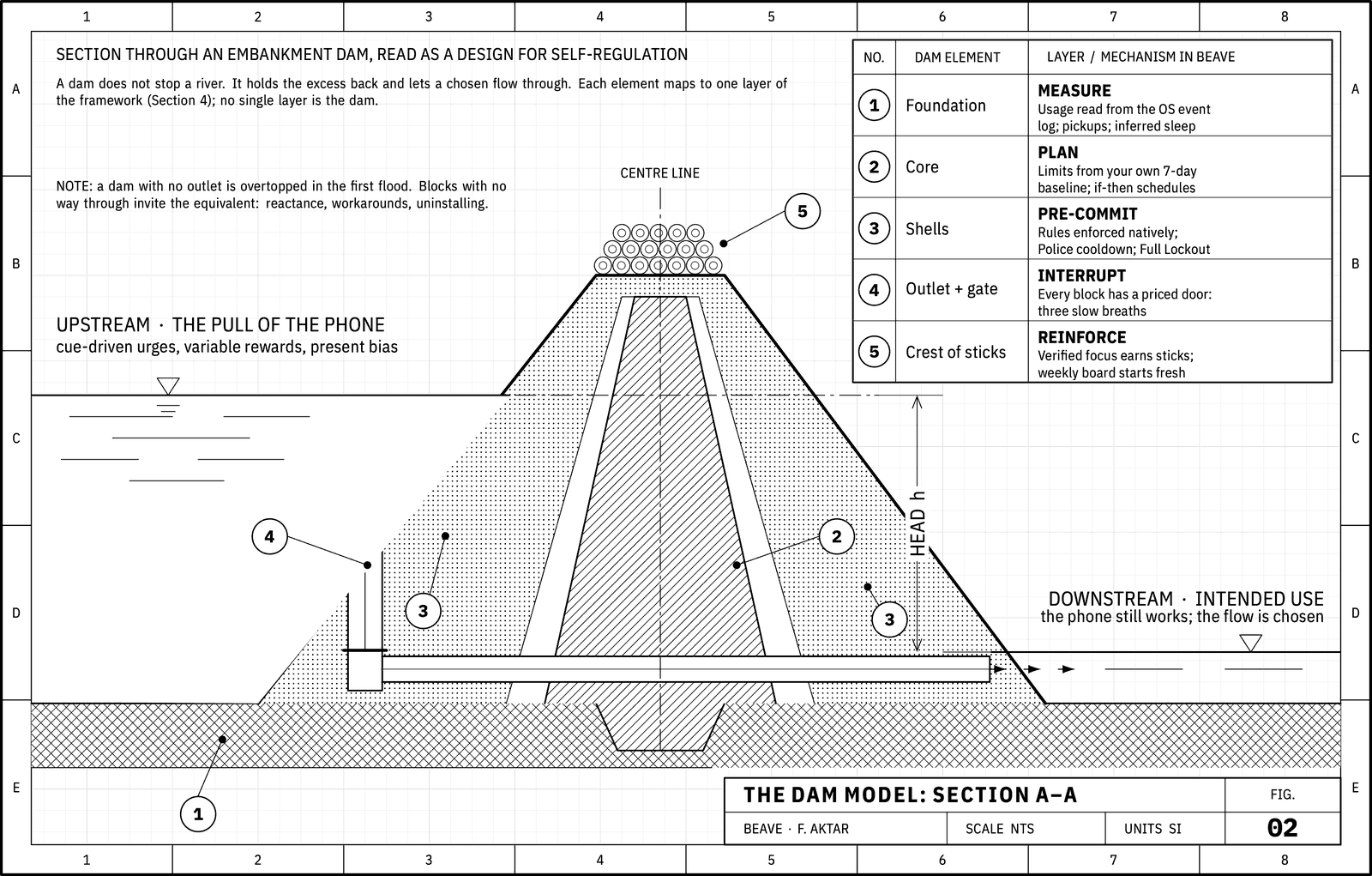
Beave is not built on productivity folklore. Each part of it is informed by published research on phone habits, attention, self-control and behaviour change. Here is what that research says, how Beave puts it to work, and where the evidence stops.
Beave measures your actual usage rather than asking you to guess it.
A meta-analysis of 106 effect sizes compared what people said about their digital media use with what their devices actually logged. Self-reports correlated only moderately with the logs and were rarely an accurate reflection of them. The association was weaker still for measures of problematic use, meaning the people most affected were often the least accurate about it. [1]
If you want to change a number, start by measuring it instead of estimating it. Beave's daily limits run against what your phone recorded, not against how the day felt.
Beave counts pickups and app opens, and open limits cap how many times a day you can start an app.
A field study of smartphone users identified what the authors called "checking habits": brief, repetitive inspections of quickly accessible content. These checks are reinforced by small informational rewards that arrive fast, they emerge without deliberate intent, and they often spill over into longer sessions on the device. [2]
The problem is usually not one long sitting, it is dozens of small ones you never decided to have. Counting opens targets the behaviour that actually repeats.
A focus session starts when you place your phone face-down, and blocked apps stay shut for its duration.
In a study memorably titled "Brain Drain", the mere presence of one's own smartphone reduced available cognitive capacity, even when the phone was face-down and powered off. People who left it in another room outperformed those who kept it on the desk. [3] Separately, receiving a notification was enough to disrupt performance on an attention-demanding task, at a magnitude comparable to actually using the phone, even when participants never touched it. [4]
Willpower is not the only thing being taxed. Putting the phone out of reach and silencing what it can interrupt you with both remove a cost you pay whether or not you give in.
Daily time limits and open limits enforce a ceiling you set for yourself.
In a randomised experiment, 143 undergraduates either limited Facebook, Instagram and Snapchat to ten minutes per platform per day, or carried on as usual, for three weeks. The limited group showed significant reductions in loneliness and depression compared with the control group. Both groups saw anxiety and fear of missing out fall, which the authors attributed to the self-monitoring itself. [5]
At larger scale, 2,743 Facebook users were randomly assigned to deactivate their accounts for four weeks. Deactivation reduced online activity, increased offline socialising, and increased subjective wellbeing. It also caused a lasting reduction in Facebook use after the experiment ended. [6]
These are experiments, not correlations, which is why they carry more weight than the usual screen-time headlines. Note also that both effects came from an actual reduction in use, not from deciding to cut down.
Blocking rules, schedules and protected mornings and nights remove the choice before you have to make it.
Work on situational self-control argues that self-control is easier when it takes the form of choosing or changing your situation, so that the unwanted impulse is weakened before it arrives, rather than resisted once it has. The earlier in the cycle you intervene, the less effort is required. [7]
In fairness, this is a live debate: later work has questioned whether situational strategies really outperform willpower-based ones, and the picture is not settled.
Deciding once, in advance, that an app is unavailable at 11pm is a different kind of task from deciding at 11pm not to open it.
Every rule you write is an if-then: if it's 9am on a weekday, then these apps are shut.
Implementation intentions are plans in the form "when situation X arises, I will do Y". Specifying the when and where of an intended action reliably improves the rate at which people actually carry it out. A meta-analysis of 94 independent tests found a medium-to-large effect on goal attainment. [8][9]
"Use my phone less" is a goal. "Instagram is blocked from 9 to 5 on weekdays" is a plan, and plans are what get kept.
Outside a focus session, unlocking a blocked app takes three slow breaths first.
In a randomised controlled study, five minutes a day of structured breathing improved mood and reduced physiological arousal, including respiratory rate, more than mindfulness meditation over the same period. The strongest effect came from the exhale-emphasised pattern, cyclic sighing. [10]
That study tested a daily five-minute practice, not a three-breath pause in front of an app. We use it as the reason the pause is a slow exhale rather than a countdown, not as evidence that three breaths will stop you opening Instagram.
The point of the gate is the gap it puts between the urge and the tap, and a long exhale is a better use of that gap than watching a timer.
Beave blocks distracting apps for the whole length of a focus session.
Research on "attention residue" shows that when you switch from one task to another, part of your attention stays stuck on the first, leaving you slower and less effective on the next one. Even a quick glance at a distracting app carries this cost. [11]
Blocking the apps that pull you away stops you paying that switching cost over and over through a session.
Every session earns sticks, and sticks build a dam on a real river.
The goal-gradient effect describes how people accelerate their effort as they get closer to a visible reward. In field and lab studies, participants who could see themselves nearing a goal worked at it faster and stuck with the programme longer. [12]
A number that only goes down is a hard thing to stay motivated by. Building something visible gives the effort a shape you can see accumulating.